Showing posts with label Geoff Lawton. Show all posts

Sunday, September 8, 2013

My Permaculture Story

Although it seems like many, many years ago, my Permaculture story began in August 2010...

I was home for vacation in the beginning of August, looking at gardening videos on YouTube and came across a series of videos on Permaculture.  I don't remember who posted them, but I remember they featured Geoff Lawton and Bill Mollison and the Permaculture Institute in Australia. I found the first video and for every waking moment of that 7 days after (and since) I consumed whatever information I could find on Permaculture.

Based on those few videos, we planned the garden beds, dry river bed (swale) and the multitude of Perennial trees, bushes and vines. We started simply with just a couple of beds and have added steadily for the past 3 years. My thinking was that if we just kept adding, we could grow quite a bit of veggies, fruit, nuts and annuals each year.

Then something happened that was completely unexpected...

For the first time ever, the course in Australia was opened up on-line for people to take. People, like me, who could not go to Australia, but wanted so much to learn everything possible about Permaculture.  This design science, this sustainable living, this food security in an uncertain world - was open to me. The price was right and I signed up for what would change my life forever. Permaculture was already such a focus for me, I believe that everyone should have the ability to eat a variety of in season foods and food insecurity is an unnecessary condition of our current society.

I took the course, over the past few months, absorbed as much information as I could, took the quiz, and turned in my project to design a sustainable existence on our 100x50 ft. lot that we live on. Not only did I see the possibilities for us, I saw the possibilities for the world.

No one should be hungry...but instead, we have the answers to live in absolute abundance.

The past Tuesday, I realized another surreal and amazing event when Geoff Lawton came to UMass Amherst, (sponsored by the Permaculture programs there) and I was able to receive my certificate in person from Geoff. He spoke first of possibilities, of changes we can all make to create a different world around us - one of abundance.

When we arrived, we weren't sure where we were, but I turned and saw Ryan Harb and Geoff Lawton walking by, as well as Jonathan from the Permaculture Food Forest of Holyoke driving by (we have purchased many of our perennial plants from him). So we followed them to the room where Geoff was speaking.

I stayed after the talk and met Geoff and received my certificate in Permaculture.  One of the most important events in my life, by far. It's just the beginning, and now I have a certificate to teach Permaculture. I have a lot to learn still, and our experiments in this little yard are helping me to understand things on a bigger scale.

I am changed. Nothing will ever be the same. To have the solution and not act is inexcusable.

That being said, I have a lot to learn and will continue to move forward - experimenting with plants and annual garden beds in our garden, as well as keeping track of the perennial trees and vines, and learning so much from the small space we are working with.

I look forward to future adventures!

The pictures are a little blurry, but it doesn't change how much this means to me.

Thank you, Geoff.


Sunday, March 31, 2013

Paw Paw Tree and the Seven Layer Forest

It was exciting to finally install the last of our "upper tree" level of the garden. The Paw Paw tree arrived on Friday, along with blueberries (that are still in the house), 5 grapevines of different varieties and a new Meyer Lemon to replace the one we had indoors that didn't make it.

In the Food Forest idea of setting up an area, there are seven layers:

1.  Canopy layer consisting of the original mature fruit trees.
2.  Low-tree layer of smaller nut and fruit trees on dwarfing root stocks
3.  Shrub layer of fruit bushes such as current and berries
4.  Herbaceous layers of perennial vegetables and herbs
5.  Ground cover layer of edible plants that spread horizontally
6.  Rhizosphere or underground dimension of plants grown for their roots and tubers
7.  Vertical layer of vines and climbers

For our little yard attempt at this: we have a very large, old Maple in the neighbors yard.
The low tree level has 4 different apples, 3 pears, hazelnut, almond, 
The shrub layer has Goumi, Jostaberry, Pink Grapefruit current, Red Current.
Herbaceous layer of perennial vegetables and herbs: herb spiral with culinary herbs, Sea Kale, Nasturtium, Arugula, Horseradish, etc.
The Ground cover layer includes peas (planted today) for fixing nitrogen, Comfrey, and we are still working on this layer.
The Roots or tubers, we have mainly Sunchokes and are looking at more of these.
The Vertical layer of vines: we have Hardy Kiwi, Concord Grapes, and 3 other variety of grapes to install.

We also have 8 annual vegetable beds - three of which we planted today with peas to fix nitrogen for the tomatoes, carrots, potatoes, and other annuals that will be growing in the beds.

My planning, right now, is for more culinary herbs, medicinal herbs, as well as pots of flowers throughout the yard and in the driveway to make use of that space. Ideally, I would like to take up the asphalt and install gravel with room for more garden beds that are not permanent.

The first explanation I ever saw about Food Forests was with Geoff Lawton from Permaculture Institute in Australia . He has helped me to see and understand that nature will work if we set up the right conditions for growth. 

The first day of having my hands in the soil again, and it all comes rushing back - winter is over and we are eating the last of our canned vegetables, and the cycle begins again. I have so much to learn, and in the garden, every day teaches me.
The corner of the yard - empty and waiting for a tree

Paw Paw Tree planted - it doesn't look like much now,
but it will be 20 feet tall x 10 feet wide (dwarf)


Thursday, February 23, 2012

Permaculture and our Hugelkultur Beds

Last Summer I was on vacation and came across a video of Geoff Lawton and Bill Mollison speaking about Permaculture and for the next 7 days (and many days since) I have watched, read, and absorbed everything I could about this topic. What is this Permaculture? It's a fairly complex idea that can be stated as simply creating the perfect situation for permanent agriculture, permanent culture. I have heard and read so many things now, but what it boils down to, in my understanding, is

Care of the planet...Care of people...Distribution of abundance.

I don't have a soapbox. I have a 50x100 ft lot in the middle of one of the biggest cities in New England, and I believe that we can supply at the very least all of the vegetables, fruits and nuts that our family needs. If they allowed chickens and goats...we would have all the protein and milk too.  I do think it is crucial that each of us thinks about where our food, clothing, etc. comes from and what it is costing other people, nature and our resources for us to have these things. I don't think it means giving up anything, but just being aware and grateful for the many gifts that this world gives us.

Two things that are always in the forefront of my mind: Plants want to grow. It's what they do! And all they need is the perfect environment to do so...and Nothing we do is failure, it's all a learning experiment and we just try until we find what works.

Our experiment this week:  Hugelkultur Beds. Sepp Holzer is one of the leaders in practicing this method. He has a few great books and some videos on-line.

It has been such a mild February that we were able to dig and prepare one of the beds this past weekend. We have a bunch of stumps from various removals of trees on our property....stumps and sticks not useful for the wood stove and that have already started to decompose. So we decided to use this resource to raise a few smaller beds.

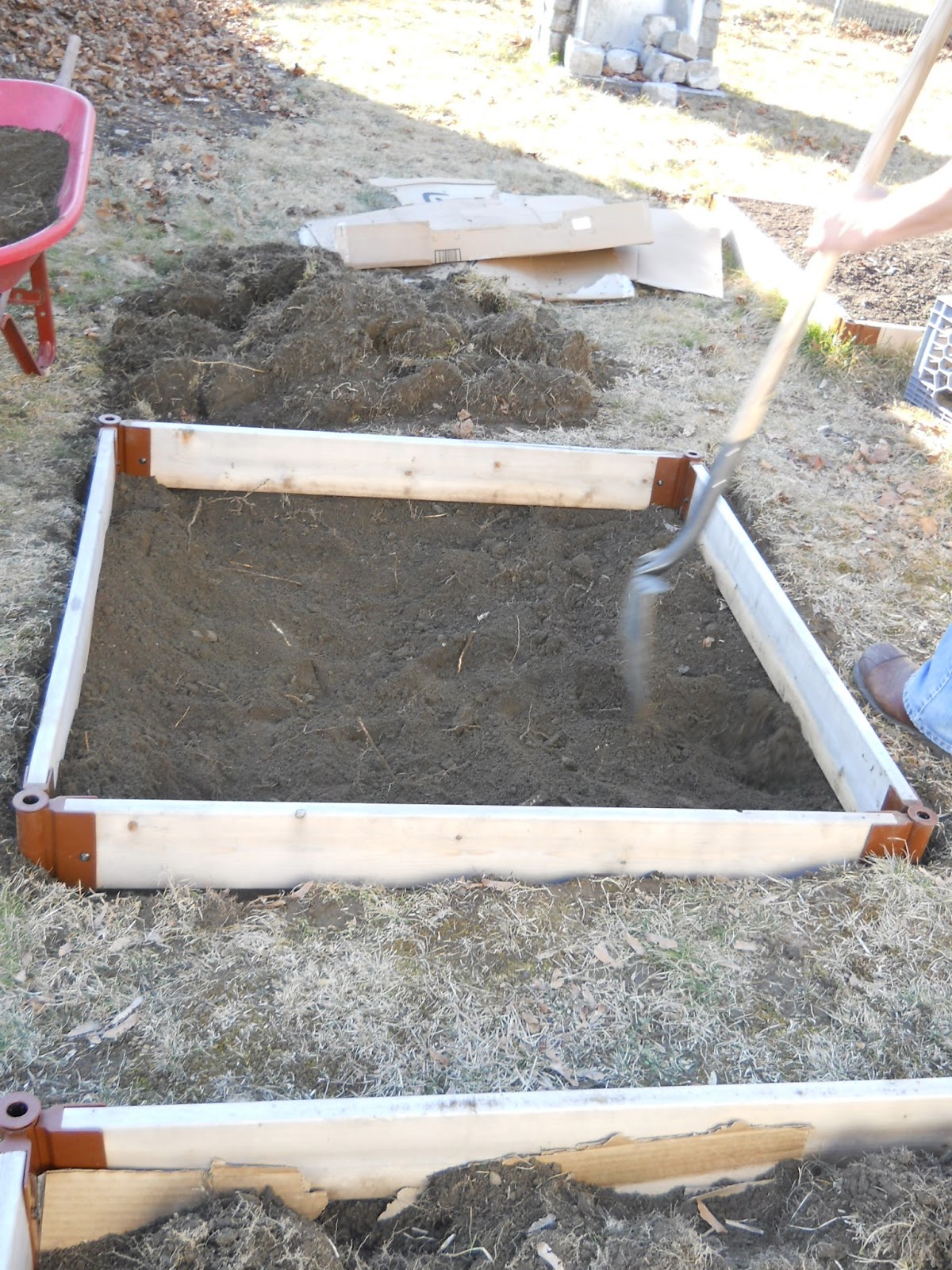
The first step is to dig the up the sod and put it aside.


Our less than marvelous "lawn" becomes useful!


Once the sod was up, we replaced the bed frame.
The frame isn't necessary, it is just part of the design we have chosen.


After digging out some soil, we placed the rotting logs in the hole. 


Then we filled in and left the sides of the bed free from logs.


Next we turned the sod upside down over the logs.
This, along with the logs will retain the moisture during the hot months.
The goal of Hugelkultur is to not have to water these beds.


We soaked the entire bed with water.


Then we replaced the soil that we dug out of the hole.


Covered the bed with a thick layer of bark and mulch.


Watered it all down again and left it to do it's magic.


The purpose of the Hugelkultur bed, in my understanding is to hold the moisture in the logs and sod and help restore the soil to a natural state. It also takes many years to break down and gives these seemingly useless pieces of rotting wood and "yard waste" a purpose.

The plan is to plant shallow rooting plants - such as lettuce and beans in this and the other two beds - so  there is a food also grown here and the soil and mulch will be held in place as well as aiding in the growth and watering of the plants.

This is all an experiment, but the very next day I saw birds  in this bed picking out bugs and the mulch is holding the soil in place. It is creating/restoring an ecosystem.  It is restoring a natural process that we have changed by clearing out our land of what we consider waste, but what is actually the necessary ingredients for the next year of growth.

There are two more beds to be dug, and with the way this "Winter" is going - at least one should be finished this weekend.  

Plants want to grow - all we need to do is provide the environment for growth! Observing nature around us - I see that all that is needed is right before me.  

In my mind I see these ideas and imagine that all the world was once a garden of Eden. There was food everywhere and nothing was lacking. I believe if we all do just a little, we can reverse this culture of consumption and have a better quality and more sustainable choice of food, clothing and life. Just on a small scale, where we are, we can all make a difference for our own lives...even just a small change in a new direction.

Life, after all is all an experiment! Try something new :)

Saturday, January 21, 2012

Northeast Organic Farmers Association Conference!


On Saturday, January 14th, we attended an all day conference for NOFA (Northeast Organic Farmers Association) at Worcester State University. This is the first time either of us have attended anything like this and it was such a great experience!

There were many workshops scheduled at 3 different times during the day, a presentation by keynote speaker John Jeavens, an organic lunch and many, many vendor booths to visit.

In the morning we went to a class about raising chickens. There is a proposal in Worcester to allow families to have 4 chickens as long as they are properly cared for and in a coop that has been inspected. We are waiting for the approval and plan to have chickens as soon as possible after it is passed. So the class was a great source of information and I learned a lot from the presenters.

We went to hear the keynote speaker John Jeavons talk about Biointensive Gardening. I am always interested in listening to the innovative ways that people are growing food in small spaces.

There was a great organic lunch of beef stew or a vegetarian soup, salad and bread and dessert – all provided by organic farms in the Northeast.

After lunch we went to a workshop presented by Jonathan Bates of the Permaculture Nursery in Holyoke MA. It was a great presentation on how to grow a lot of different food in a small area – and his personal experience of planting a dirt lot and creating a garden out of it using Permaculture methods. He does a lot of planting and experimenting with different plants, and also sells those that do well in our area. We have already ordered several different berries, kiwi and grape vines, and some other plants to add to our collection for the Spring.

After the workshop – we went to the vendors and looked at what types of organics are available in our area and signed up to be contacted by the Massachusetts Local Food Coop – they do monthly orders for farms in the state and we can have access through them to some things that are not available to us otherwise.

What I took away from the workshop, is the encouragement that so many young people are actively seeking information about gardening, farming and organics, and are concerned about the future and providing quality for their lives.

I am sure that we can use our yard and grow enough fruits, vegetables, etc. to supplement the bulk of our groceries and get our meat from the food coop.

What I am most encouraged about is how many fruits and vegetables – plants, vines and trees – are perennial and will only need to be planted once, but will continue to grow for years; And that there is a wealth of information on-line to read and study to make our garden a success. I am especially interested in the Permaculture information: restoring the balance of an ecosystem so plants and people thrive. Abundance.

I know what it is like to put my hands in the dirt and what it feels like to work the earth creatively. It’s like waking up and everything else becomes clearer. The petty things of life fade away and what is left is the essence of who I am as a human being.

My connection to nature is a peaceful, healing experience and I had been away from it far too long….

Beautiful Birch trees at Crow Hill