Showing posts with label Hugelkultur. Show all posts

Saturday, April 14, 2012

We don't grow food

We did dig the hole, and build the Hugekultur bed, and put the peas into the ground...but we did not grow the plants.  I think this is one of the most important things about Permaculture and the thinking around restoring the soil...food will grow, and we have to understand our place in this. We aren't supposed to mono crop fields, strip the already deficient soil of nutrients and replace them with chemicals. Plants already want to grow and just need the right set of conditions to do so. It does take some work in the beginning, but plants want to grow, and we want to eat. It is really a very simple equation that gets way too complicated.

Peas planted in March - frost resistant and restore nitrogen to the soil for the
lettuces that will grow in this bed in a few weeks.
We planted four different types of peas - four different beds. Two Hugelkultur and two regular raised beds. All mulched with straw or bark mulch and they are all growing just fine with frosts and not much rain. We water them when we need to and it's good to know that their little roots are restoring the nitrogen in the soil. Again, we don't know where this will lead - or what will happen over the next few weeks, but as long as the soil is ready for the kitchen garden (tomatoes, peppers, lettuce, etc) that is all we need. We could just add nitrogen to the soil, but isn't this way is much more interesting? Letting the plants do what they are meant to do...


Sunday, April 1, 2012

Herb Spiral


Yesterday it was finally time. The pieces and parts of things came together and the time was right to convert one of our raised beds into an herb spiral.


An herb spiral is basically a round herb garden with the height to give more growing area. Plants that love the sun are planted on the south side, and plants needing shade are planted on the north side. Those needing less water - near the top and those needing the most at the bottom. Also, a main reason for the herb spiral is to have a space near to the house that is easily accessible to pick herbs.


I will be adding some sort of water pool at the bottom for water plants and critters and creatures that are thirsty.


We started out with the bed and removed the framing to reuse on another raised bed.


Raised bed in the center will be the herb spiral

With the frame removed.

We dug a hole in the center to put a log in to stabilize the middle. Also, my thinking is that it will take many years for the log to break down and will give the warmth and nutrients to the herb garden.

Hole dug out of the middle


Log in place.

And then we started to use the cedar edging to form the spiral...taking off the corners and creating a gradual raised path around the log...

The beginning of the spiral.
Finishing the spiral.
View from the other side.


So now this combination Hugelkultur/Herb Spiral/Raised bed awaits planting at the end of April and beginning of May. We have 20 or so different herbs, both culinary and medicinal to plant. Also, the 4 corners that were eliminated will become 3 flower patches and a small water pond. There is still much to do, and having the foundation of spiral done brings us a little closer to getting the seeds in the ground and seeing what this experiment brings.

Monday, March 26, 2012

More Foundational Garden Work

As the warm weather stayed, we were able to work more outside on the foundational and structural part of the gardens...The actual planting, for the most part won't happen until May, but so much can be done to prepare.


A neighbor offered to drop off mulch...a pickup truck full, so we were able to decide where beds would go and develop more of the form of the paths and design of the garden.  Basically, we put 6+ inches of mulch on the previously laid cardboard, newspaper and mulch and then also laid out cardboard and newspaper to form new beds. 


We also bought chain to put across the old clothesline, so when the concord grapes and kiwi vines arrive, they will have a place to grow.
Where our fruit vines will grow


Four of the beds have since been planted with four different variety of peas to restore the nitrogen to the soil before we plant more veggies in May.


With each step, and each project, we make observations and make adjustments to the plan. The fruit and nut trees are ordered, the mints have arrived and are waiting inside and the culinary and medicinal herb seeds have arrived. 


Next, the herb garden! 


One of the things I enjoy most is telling people what we will be growing this year, or trying to, as everything is an experiment. The usual question is "How much land do you own?" and I answer 100x50 - but we are only using about 40x40 right now - and there are still huge open spaces! It doesn't take much to grow some food, everyone can do it. 


One last thing I would like to share is that the flower bulbs I planted just before the October snowstorm are starting to come up! It's pretty much a miracle to me. Plants want to grow! =)


Thursday, February 23, 2012

Permaculture and our Hugelkultur Beds

Last Summer I was on vacation and came across a video of Geoff Lawton and Bill Mollison speaking about Permaculture and for the next 7 days (and many days since) I have watched, read, and absorbed everything I could about this topic. What is this Permaculture? It's a fairly complex idea that can be stated as simply creating the perfect situation for permanent agriculture, permanent culture. I have heard and read so many things now, but what it boils down to, in my understanding, is

Care of the planet...Care of people...Distribution of abundance.

I don't have a soapbox. I have a 50x100 ft lot in the middle of one of the biggest cities in New England, and I believe that we can supply at the very least all of the vegetables, fruits and nuts that our family needs. If they allowed chickens and goats...we would have all the protein and milk too.  I do think it is crucial that each of us thinks about where our food, clothing, etc. comes from and what it is costing other people, nature and our resources for us to have these things. I don't think it means giving up anything, but just being aware and grateful for the many gifts that this world gives us.

Two things that are always in the forefront of my mind: Plants want to grow. It's what they do! And all they need is the perfect environment to do so...and Nothing we do is failure, it's all a learning experiment and we just try until we find what works.

Our experiment this week:  Hugelkultur Beds. Sepp Holzer is one of the leaders in practicing this method. He has a few great books and some videos on-line.

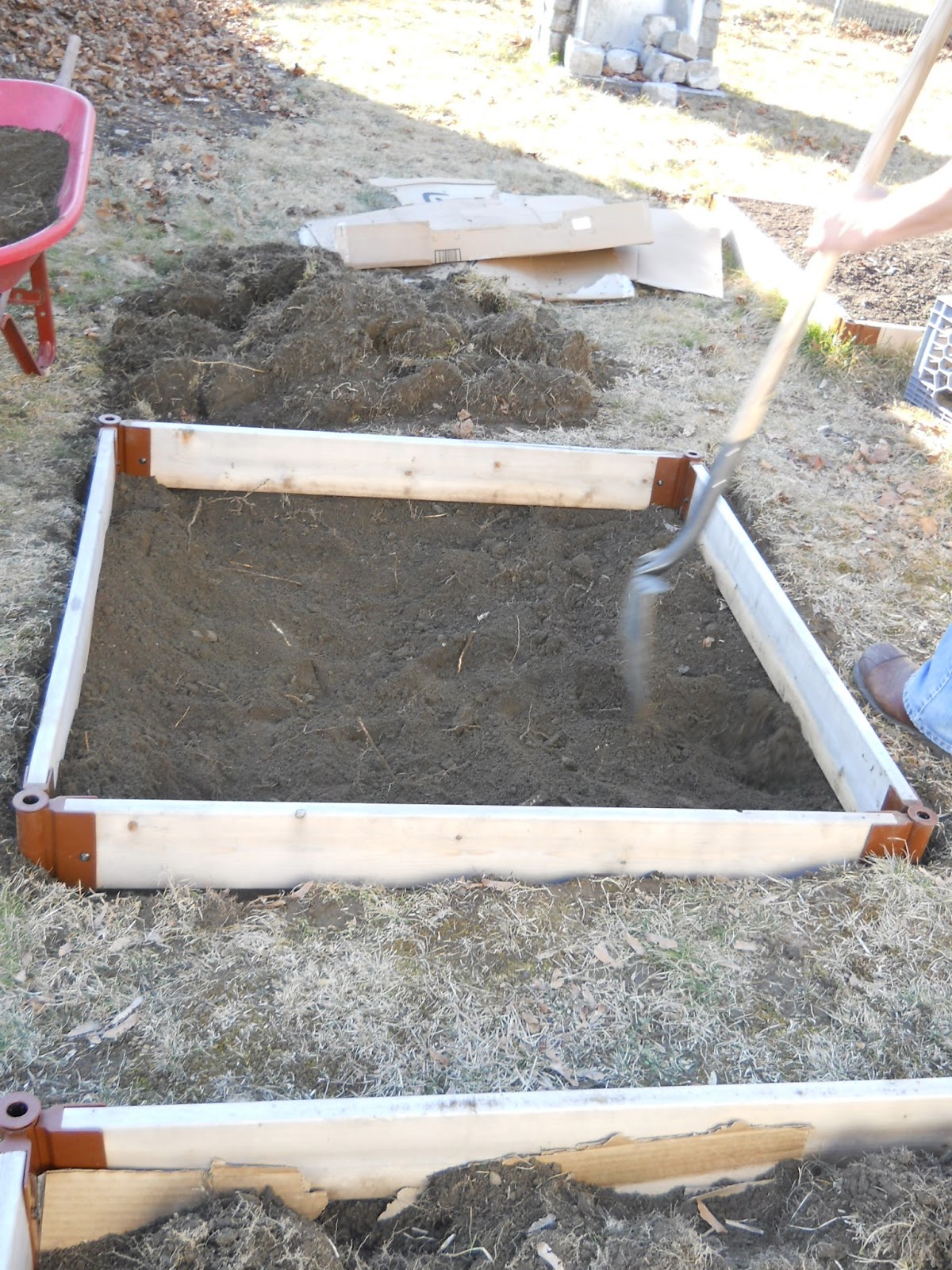
It has been such a mild February that we were able to dig and prepare one of the beds this past weekend. We have a bunch of stumps from various removals of trees on our property....stumps and sticks not useful for the wood stove and that have already started to decompose. So we decided to use this resource to raise a few smaller beds.

The first step is to dig the up the sod and put it aside.


Our less than marvelous "lawn" becomes useful!


Once the sod was up, we replaced the bed frame.
The frame isn't necessary, it is just part of the design we have chosen.


After digging out some soil, we placed the rotting logs in the hole. 


Then we filled in and left the sides of the bed free from logs.


Next we turned the sod upside down over the logs.
This, along with the logs will retain the moisture during the hot months.
The goal of Hugelkultur is to not have to water these beds.


We soaked the entire bed with water.


Then we replaced the soil that we dug out of the hole.


Covered the bed with a thick layer of bark and mulch.


Watered it all down again and left it to do it's magic.


The purpose of the Hugelkultur bed, in my understanding is to hold the moisture in the logs and sod and help restore the soil to a natural state. It also takes many years to break down and gives these seemingly useless pieces of rotting wood and "yard waste" a purpose.

The plan is to plant shallow rooting plants - such as lettuce and beans in this and the other two beds - so  there is a food also grown here and the soil and mulch will be held in place as well as aiding in the growth and watering of the plants.

This is all an experiment, but the very next day I saw birds  in this bed picking out bugs and the mulch is holding the soil in place. It is creating/restoring an ecosystem.  It is restoring a natural process that we have changed by clearing out our land of what we consider waste, but what is actually the necessary ingredients for the next year of growth.

There are two more beds to be dug, and with the way this "Winter" is going - at least one should be finished this weekend.  

Plants want to grow - all we need to do is provide the environment for growth! Observing nature around us - I see that all that is needed is right before me.  

In my mind I see these ideas and imagine that all the world was once a garden of Eden. There was food everywhere and nothing was lacking. I believe if we all do just a little, we can reverse this culture of consumption and have a better quality and more sustainable choice of food, clothing and life. Just on a small scale, where we are, we can all make a difference for our own lives...even just a small change in a new direction.

Life, after all is all an experiment! Try something new :)